Built for the swing this suburb actually sees
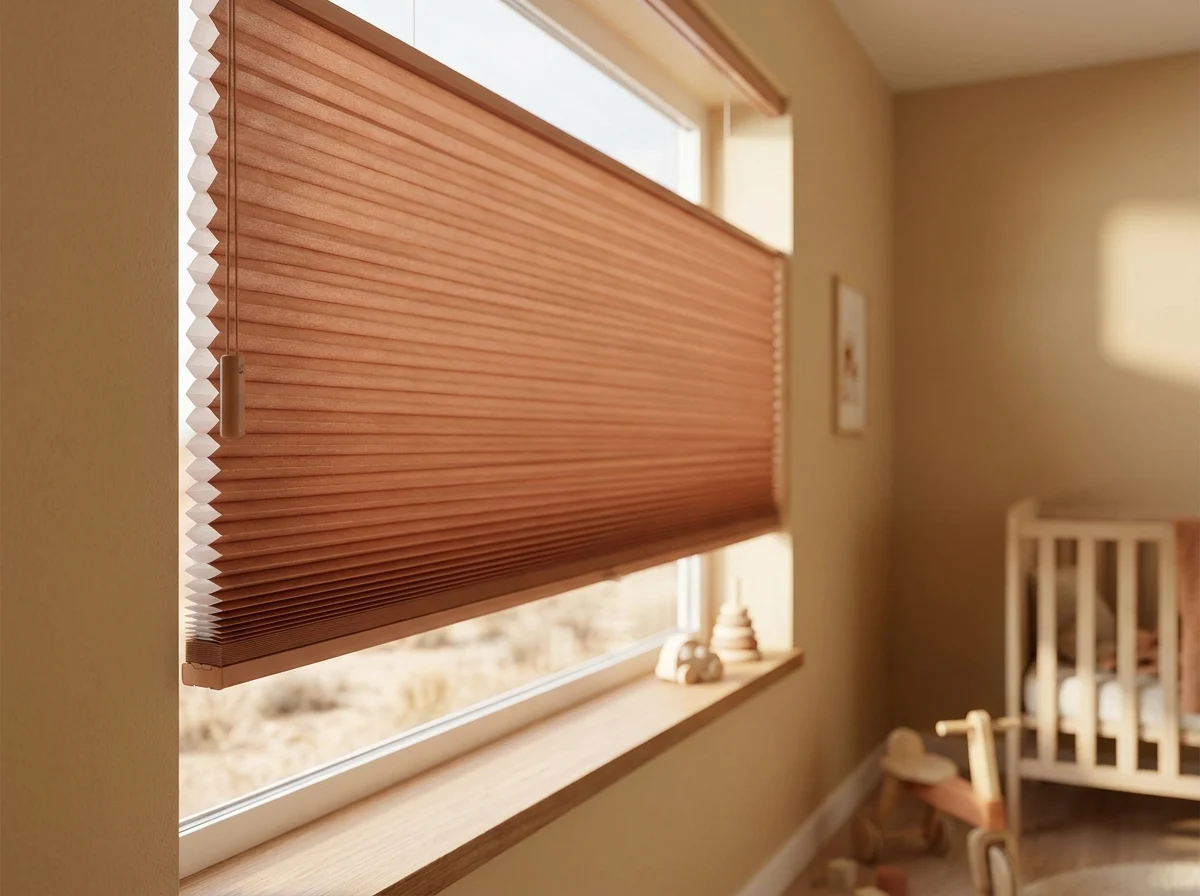
Kuils River runs from around 26°C by day in February down to roughly 10°C by day in July and August — a real seasonal swing that a small bedroom or nursery feels more than a large open-plan lounge does. Trapped air is genuine insulation: a single cell helps in a mild room, a double cell does more work through the coldest and hottest weeks, and the cell structure damps sound too, which matters on a street-facing room in a closer-set estate.
Where the money is best spent
Bedrooms and nurseries first — dark, quiet and warm is the combination young families ask for most, and a blockout cell fabric delivers all three with the thermal bonus a plain blockout roller doesn't have. A top-down/bottom-up version keeps street-facing windows in Zevenwacht or Klein Zevenwacht private at the bottom while still letting sky and light in at the top, which most estate architectural guidelines are comfortable with.
The value case
This is a genuinely mid-to-premium product, and it's worth being upfront about that — but for a suburb that markets itself on value, a cellular blind in the rooms that need it most (a nursery, a main bedroom, the room above a garage that's always either baking or freezing) is usually a smarter spend than upgrading every window in the house to it.
The room above the garage is always the one everyone complains about — this is usually the fix, not another aircon.
On-site measure, Kuils River- Light-filtering or blockout cell fabrics
- Single or double cell for mild rooms vs serious thermal swings
- Top-down/bottom-up for privacy at the bottom, light at the top
- Cordless or motorised, the slimmest stack of any blind when raised
What a cellular blind costs
Cellular blinds are dearer than a flat fabric because the honeycomb is insulating as well as shading — which is the whole reason to fit one on a west wall here. Installed, it works out at R1,500 to R2,800 the square metre on a cord or a cordless lift, and R3,000 to R4,800 with a motor in the head rail. Double cells, blockout linings and a top-down-bottom-up head rail all sit at the top of each band.
Narrow openings carry a minimum charge, since the head rail and the visit are the same work at any width. The bands help you plan; the figure per window is settled at the free measure and put in writing.
Ready to measure your windows?
The measure costs nothing, the quote is written out per window, and you're under no obligation.